


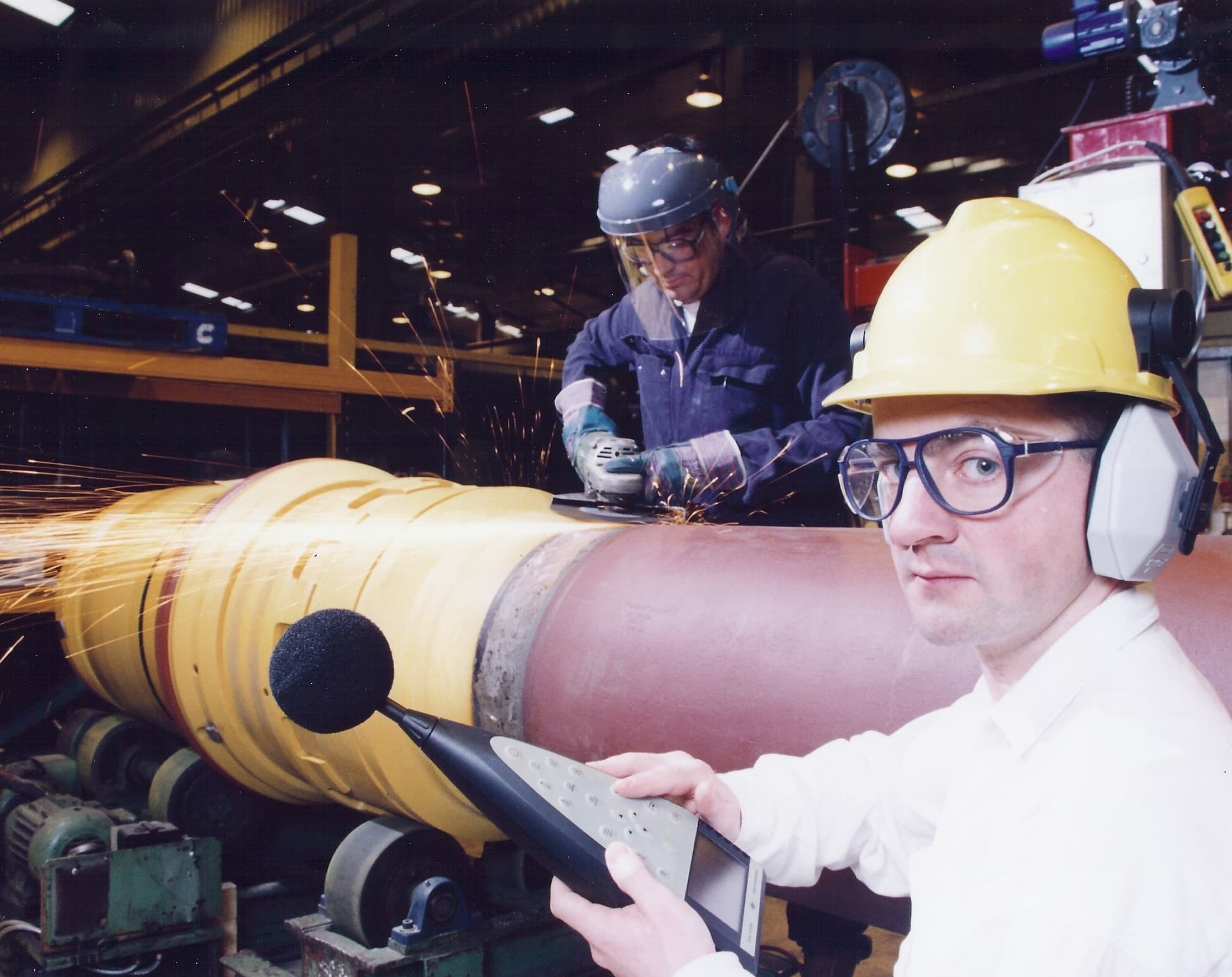
Most instructions to carry out workplace noise assessments come directly from the company’s health and safety manager, though some come from health and safety consultants.
We are delighted to have been engaged regularly to carry out workplace noise assessments by many of the following companies:
Can anyone guess why we would have done a workplace noise assessment for these organisations?
If the employees work at fixed positions, the noise will be measured beside each person. If the employees move around, the noise will be measured as they do this. The noise levels measured will then be combined with information on work patterns, shift durations, meal and tea breaks, to determine the daily personal noise exposure level, LEP,d, of the employees. We then compare the employees’ LEP,d to the lower and upper exposure action values defined in The Control of Noise at Work Regulations 2005. We also measure the peak sound pressure levels for comparison to the peak action value, of 140dB(C), though this is not usually exceeded.
If appropriate, our report will include recommendations on noise control of machines and tools, provision of acoustic enclosures, havens, barriers and absorption, setting up of hearing protection zones, provision of suitable and effective hearing protection, and information to employees. In short it will be “competent” in terms of the Regulations, providing you with all the necessary advice that you will need to ensure you can then comply with the law.
We can normally carry out noise assessments at one or two day’s notice, if you are under pressure from the health and safety inspector, or insurance company. If we say we will get the assessment to you by a certain date, we will.
We use only Brüel & Kjær instruments. These are the “Rolls Royce” of acoustical instrumentation and give more accurate results than some of the meters used by our competitors. This is important as inaccurate readings can lead to you having to incorporate expensive noise control measures in your factory, which may not, in fact, be necessary.
Certain companies conduct what they call “workplace noise assessments” for lower fees than we quote. This is because they do not conduct the assessment as thoroughly as we do. In particular, their approach may involve a technician, (one company even sends a secretary), simply fitting noise dosemeters to the employees at the start of the day, leaving the premises and collecting the dosemeters a few hours later. The disadvantage of this method is that dosemeters always record higher noise levels than are actually present, due to body reflections and employees singing, shouting into and otherwise tampering with the instrument. In turn, this means the employer has to pay for hearing protection and/or noise control that is not in fact needed. The acceptance of an assessment of this type can therefore be a false economy. Furthermore, the use of dosemeters precludes the provision of the detailed advice on noise control which is required by The Control of Noise at Work Regulations 2005. To then complete the assessment properly, companies using dosimetry will have to revisit the premises to carry out further noise level measurements with a sound level meter, usually for a further, much larger, fee.
Another approach is such that the company carry out very basic measurements and give a general indication that the noise levels, not the exposure of the employees, which is virtually always lower, are within the lower or upper action values as appropriate. This again is a false economy as it can leave you providing noise control/ hearing protection where it is not needed. Alternatively, you might have to instruct the company to return to the premises to re-measure the noise and conduct a proper assessment, again for an additional, much larger fee.
To put the above into perspective, during a discussion with a specialist Health & Safety Executive (HSE) inspector responsible for noise in Scotland, we learned that 60% to 70% of all noise assessments submitted to the HSE are rejected on the grounds that they are not competent as prescribed in the Regulations. Charlie Fleming Associates has carried out dozens of assessments and have never had so much as a query from the HSE.
Measurement Instruments and False Economies
Should you see fit to commission us to conduct the assessment, we will use a Brüel & Kjær Type 2250 Hand-held Analyzer to measure the noise. This is the most accurate and reliable hand-held sound level meter available on the market, and as such it is ideal for conducting a thorough analysis of the noise. Again please bear in mind that an assessment conducted with a less accurate meter may be a false economy as it may lead to noise control and provision of hearing protection where they are not actually necessary.

Proin ultrices metus idve eget rhoncus eut quis lacinia amet orci lorem ipsum amet.

Proin ultrices metus idve eget rhoncus eut quis lacinia amet orci lorem ipsum amet.

Proin ultrices metus idve eget rhoncus eut quis lacinia amet orci lorem ipsum amet.

Proin ultrices metus idve eget rhoncus eut quis lacinia amet orci lorem ipsum amet.