
Planning applications for residential developments often have conditions attached relating to the noise of an adjacent road, railway, factory, pub, restaurant, night-club, etc. The condition may stipulate that a noise impact assessment (NIA) be carried out.
The planning condition may stipulate that it be carried out in accordance with Technical Advice Note TAN 2011 Assessment of Noise and Planning Advice Note PAN 1/2011 Planning and Noise, which are published by the Scottish Government, but many local authorities specify that their own methods and noise level limits be adopted. To deal with a condition like this, the noise is measured and the results used to calculate what level will exist in the new dwellings. In this respect we have experience in noise affecting houses, flats, care homes, hospitals, student residences and barracks. We can also deal with conditions relating to railway vibration.

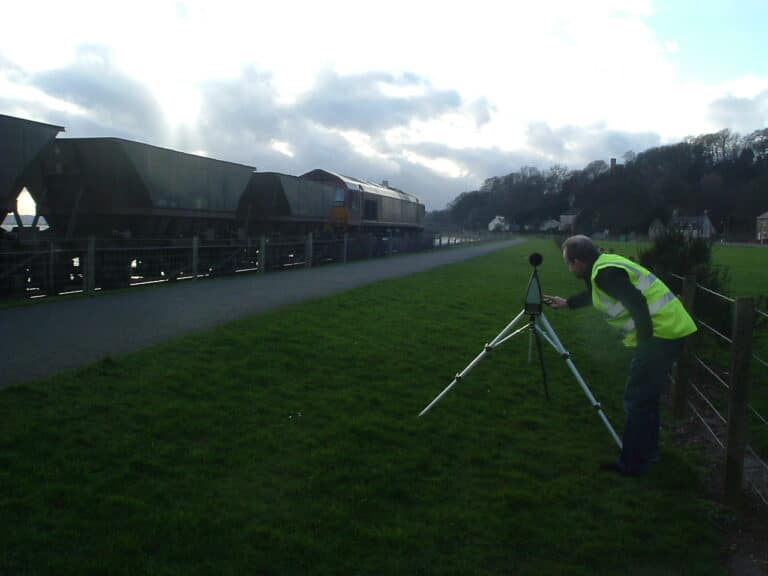
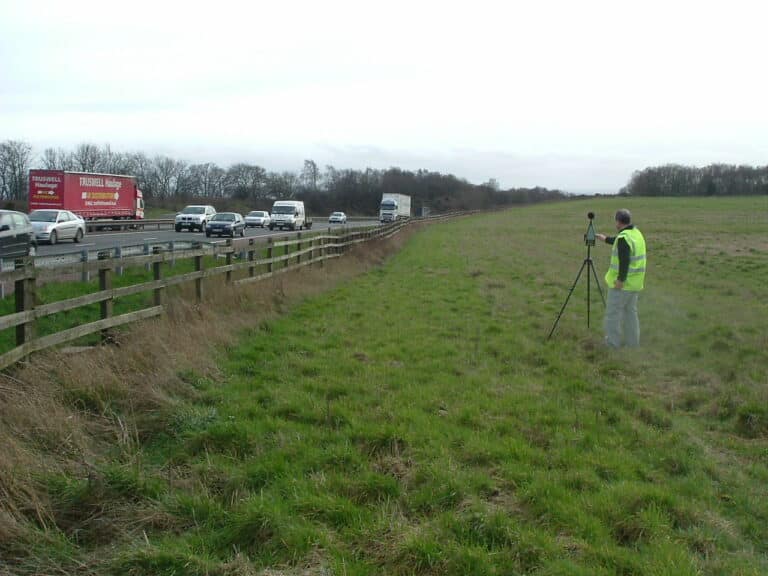
We work on residential planning applications at a rate of around one a week. Hence, since the company’s inception in 1997, we have worked on almost 1500 such applications. This, together with Charlie’s experience in environmental noise from 1983 onwards, means that we have a great deal of knowledge in this field. This means we know how to carry out the measurements and calculate noise levels in the proposed houses/flats, to obtain the best results. It also means that if a site is too noisy, we can recommend what to do to progress the planning application. As we work out noise levels more accurately than some of our competitors, our recommendations to reduce the noise can be much less costly than theirs.
Charlie has also given evidence to several public inquiries relating to planning appeals.
We also work to control the ingress of noise into hotels, offices, schools, libraries, places of worship, hospitals and other health care facilities, though these are not usually conditioned by the local authority.
The most common sources of noise, with which we deal, are road traffic, railway, aircraft, pubs, restaurants and night-clubs, and industrial. Noise of mechanical services plant, such as ventilation systems, boilers, chillers, condensers, auxiliary power generators, air source heat pumps, pumps and lifts, is also dealt with frequently. This type of noise may be coming from a neighbouring building, or it may be from within the application property itself.
Having worked on well over a thousand residential planning applications, they are too numerous to list. There are too many different industries with which we have dealt to list, but the ones which come up most frequently are; garages and car body repair shops, blacksmiths and other metal working shops, sawmills, manufacturing joinery, construction, waste water treatment, waste transfer stations, kennels, and, rather curiously, nurseries. Within industry, it is often the noise of heavy goods vehicles being unloaded and loaded which is most problematic, and so we have a great deal of experience of this type of noise.
As mentioned above, having carried out over a thousand of these jobs, they are too numerous to list. We are blessed with repeat business from many blue chip companies, as you will see in our Satisfied Clients section.
Most are carried out in Edinburgh, Glasgow, the central belt, Aberdeen and Dundee, but we have been as far afield as Beauly in the north, and Eyemouth in the south. A while ago Charlie went down to Stockton-on-Tees in England to do a road traffic noise assessment, and indeed we will be delighted to quote for jobs anywhere in the UK and Ireland.
Most instructions to carry out noise impact assessments/surveys for residential planning applications are taken from property developers, builders, architects, project managers and planning consultants.
We are delighted to be asked regularly to carry out noise impact assessments for:
Some local authorities in Scotland have their own guidance on noise. Some stipulate that it be considered as prescribed in The Scottish Government publications Planning Advice Note PAN 1/2011 Planning and Noise and Technical Advice Note TAN 2011 Assessment of Noise. The procedures set out in the latter document are used in relation to road traffic, railway, aircraft and industrial noise, whereas that from industry, restaurants, pubs, night-clubs and mechanical services plant is dealt with slightly differently. What is always required, regardless of where you are, is that we measure the noise and then calculate what the levels will be inside the houses or flats. If they exceed the limits applied by the local authority we will recommend how to reduce them so that they comply.
All local authorities specify daytime and night-time noise level limits, though it is extremely rare for a council to request that a full 24-hour noise survey be carried out. The daytime levels can be calculated very accurately based on measurements of the noise made over 3 consecutive one-hour periods. Details of this measurement technique are set out in the Department of Transport document titled Calculation of Road Traffic Noise. Charlie Fleming Associates measures the noise over a three-hour period and calculates the 16-hour daytime and 8-hour levels from the results. We have used this technique before all over Scotland, and indeed once in England, and the results have always been accepted by the local authority’s officers.
As with traffic noise, all local authorities apply daytime and night-time noise level limits, though it is extremely rare for a council to request that a full 24-hour survey be carried out. It is usual to measure the noise of the passing trains over a shorter period and then to calculate, using a procedure set out in the Department of Transport document titled Calculation of Railway Noise, together with timetabling information from Network Rail, the 16-hour daytime and 8-hour night-time levels. This technique is also accepted by Scotland’s local authorities.
With respect to vibration from railways, most local authorities refer to British Standard 6472-1:2008 Evaluation of human exposure to vibration in buildings – Vibration sources other than blasting (BS 6472). It is usual to measure the vibration of the trains, in accordance with this standard, over the same 2 to 3 hour period that the noise is being measured. What is known as the vibration dose value can then be computed from these results and the timetabling information, in much the same way as the daytime (07.00hrs to 23.00hrs) noise level. The day and night vibration dose values can then be compared to the criteria for human perception given in BS 6472. This approach is accepted by local authority planning officers in Scotland.
Local authorities apply daytime and night-time noise level limits to aircraft noise. Airport operators monitor the noise around their sites continuously, and produce what are called noise contours from the results. The contours tell us what the daytime noise level is on your development site. The night-time level can be calculated from the contours and flight schedules.
As noise from factories and industrial production plants varies with time, it has to be measured over a period which will encompass the different levels. A period of 4 hours is usually long enough to build up a good picture of how the noise varies, and it this measurement period that we usually adopt. In any event, it is very unlikely that the planning officer will accept a shorter measurement period.
Sometimes local authority officers ask for measurement and assessments of industrial and commercial sound to be carried out to British Standard 4142:2014+A1:2019 Methods for rating and assessing industrial and commercial sound (BS 4142). We try to discourage the use of this standard because it almost invariably concludes that the noise will lead to complaints. In turn, that means that your development does not proceed, or expensive noise control measures have to be put in place to secure planning permission. We present strong arguments against its use, primarily because its conclusions are based on a background noise level to which the, prospective, residents have not been exposed, and, when new residential development is proposed, we do not know what this is. (BS 4142 is appropriate for new industrial premises proposed adjacent to existing housing).
This, being temporary, is not usually of concern to the planning officer. Occasionally, on long term projects, such as motorway extensions and major road developments, it is necessary to consider it. In this case we measure the noise and deal with it in much the same way as we would any other industrial noise.
The noise emanating from pubs and night-clubs varies according to what is taking place within the establishment. Live entertainment usually generates the greatest noise, and so it is necessary to measure it when a band, DJ or karaoke, is on. The noise of licensed premises also has to be measured when the premises are busy, and hence noisy, which is usually on a Friday or Saturday night. As the noise usually increases in level as the evening progresses, it has to be measured between around 22:00hrs and whenever the premises close.
Virtually all local authorities in Scotland apply a criterion known as “inaudibility” to this type of noise. That is, that the entertainment noise must not be audible in the proposed houses/flats. Having calculated the level of noise likely inside the proposed dwellings, we compare this to what is known as noise rating (NR) 15 as that is usually taken as being “inaudibility”.
As mechanical services noise does not, generally, vary much with time, it can be measured relatively quickly, over an hour or so. (Though sometimes we do have to wait for a condenser to cut in, boiler to fire up, and so on).
Virtually all local authorities in Scotland apply a limit of noise rating (NR) 35 to this type of noise during the day, and NR25 to it at night. Having calculated the level of noise likely inside the proposed dwellings, we compare this to NR35 or NR25 as appropriate.
A single measurement position is usually sufficient, in all but the largest development sites, or ones with more than one noise source affecting them. The position selected is the one in which the most exposed house or flat will be built. The principle in this is that, if the noise is acceptable at the most exposed house, it follows that it will also be acceptable at the other, less exposed ones. In any event, the planning officer will not accept the results of measurements made on quiet parts of a development site, away from the noise source in question.
We know, from what we have seen and heard, that our service is better than that offered by many of our competitors. The many reasons for this follow.
We can normally carry out noise surveys at one or two day’s notice, to fit in with your planning application programme. (We fully appreciate the pressure you are under to get information to planning officers by a certain date and the cost implications if you miss it). If we say we will get the information to you by a certain date, we will.
Even if work has started on site, we do not insist that it stops while the noise is measured, we can usually work around it somehow.
We can compete on price and give 15% and 20% discounts for retained commissions.
When we provide a quotation we stick to it. That is what you pay, regardless of how long it actually takes us to carry out the assessment.
We use only Brüel & Kjær instruments. These are the “Rolls Royce” of acoustical instrumentation and give more accurate results than that used by some of our competitors. This is important as inaccurate readings can lead to you having to incorporate expensive noise control measures in the houses/flats, or site layout, which may not, in fact, be necessary.
Few, if any, firms in Scotland have the equipment necessary to measure railway vibration properly. We use Svantec instrumentation which was specifically designed for work to BS 6472 and is widely held to be the best available on the market. Some of our competitors use what are called geophones, which tend to over-estimate the vibration. In turn, that can make a site un-developable, or mean that expensive control measures have to be put in place which not actually necessary.
Noise measurements are made by Peter Dunlop or Sandy Lamb. Other companies may leave their instruments supervised by a technician or person with no knowledge of acoustics. (Both Peter and Sandy have honours degrees in audio and music technology, many years’ experience in environmental noise, and are members of the Institute of Acoustics). The risk in this approach is that the person may not notice if the measurements are corrupted by extraneous noise, such as that from road works, construction work, aircraft, livestock, pedestrians, birds, etc. What, on the face of it, are slight differences in the intervening ground between the road/railway/factory and the measurement position, can also significantly affect the measured sound levels. Only the experienced acoustician can assess these in-situ and ensure that the measurement position will not prejudice the progress of the planning application. Both these factors, of extraneous noise and reflections, would lead to artificially high levels being reported. In turn, this might mean that you have to incorporate noise control measures in the houses/flats which are not in fact necessary. Otherwise, it might mean that your application fails, or that you have to include expensive noise control measures that are not actually necessary.
Analysis of the results, calculations and preparation of the report are carried out by Peter, and checked by Sandy, or vice-versa. Sometimes they will ask Charlie to check calculations and reports.
From start to finish your noise impact assessment is dealt with by experienced, highly qualified acousticians.
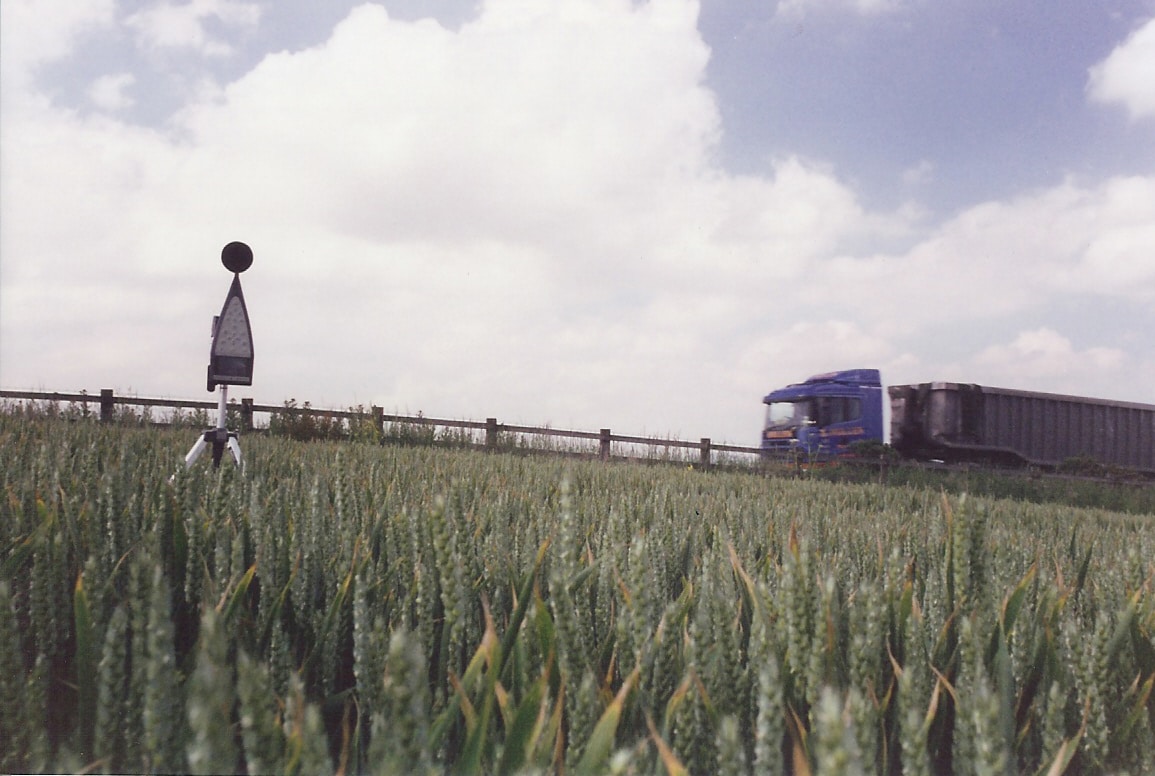
Other companies’ methods can lead to expensive noise control measures being put in place which are not necessary. The reasons for this follow.
Other companies may leave their instruments supervised by a technician or person with no knowledge of acoustics. The risk in this approach is that the person may not notice if the measurements are corrupted by extraneous noise, for example, if dealing with traffic noise, that from local industry, trains, building works, aircraft, birds, pedestrians, wind in trees and other vegetation, etc. What, on the face of it, are slight differences in the intervening ground between the road and the measurement position, can also significantly affect the measured noise levels. Only the experienced acoustician can assess these in-situ and ensure that the measurement position used is not prejudicing your case. Both these factors, of extraneous noise and reflections, would lead to artificially high levels being reported. In turn, this might mean that you have to incorporate expensive noise control measures in the design of the houses or flats which are not in fact necessary. You may lose a number of houses/flats for the same reason, having to build them further from the road, or construct an acoustic barrier in the form of a bund.
Some companies leave a sound level meter unattended for 24 hours. The problem with this is that you do not know what has made the noise. For example, the noise of gulls and crows early in the morning can be considerably greater than that of the traffic. This, together with other sources of noise, might again mean you have to incorporate expensive noise control measures in the design of the houses or flats which are not in fact necessary. Alternatively, you may lose a number of houses/flats because of a stand off to the road, or the construction of an acoustical barrier bund.
Calculations performed by some other consultants, whose work we have seen, use quick and relatively simple equations, which err on the side of caution. In this, they tend to over-estimate the noise levels likely in the houses or flats. Again this might mean that you have to include expensive noise control measures which are not necessary, or lose a number of plots. Charlie Fleming Associates uses very complex equations which work out the noise levels more accurately, and hence any noise control measures will be more precisely specified than they would perhaps be by other consultants.
In one year alone, we were commissioned 6 times to carry out work which had been done badly by other “acousticians”. In these cases the first fee, paid to the other firm, was a waste of money and accepting the cheaper quotation proved to be a false economy. More importantly, in one case, had the noise control measures suggested by another firm been implemented, over £200,000 would have been spent. Our more detailed measurements showed that the control measures were not necessary. In another, the glazing specification, prepared by the other consultant for a large housing development in Aberdeen, was reduced once we had measured the noise and calculated the internal levels more carefully. This saved the client hundreds of thousands of pounds. In another case, our more precise calculations meant that the developer was able to double the number of houses he could construct on the land. In the remaining cases, the reports by the other firms were rejected by the planning officers, and the developments did not proceed until we had dealt with them.
This continues, every year with around three or four jobs coming to us because other “acousticians” have not managed to carry out the work satisfactorily.

Proin ultrices metus idve eget rhoncus eut quis lacinia amet orci lorem ipsum amet.

Proin ultrices metus idve eget rhoncus eut quis lacinia amet orci lorem ipsum amet.

Proin ultrices metus idve eget rhoncus eut quis lacinia amet orci lorem ipsum amet.

Proin ultrices metus idve eget rhoncus eut quis lacinia amet orci lorem ipsum amet.