
With many industrial and commercial planning applications, the local authority planning officer includes a condition to the effect that the noise from the development must not disturb residents of houses, flats or other residential accommodation in the vicinity.
We have worked on planning applications for a wide range of industries, night-clubs, pubs, restaurants, office blocks, shops, sports facilities and gyms. At one stage we even worked on a planning application for a brothel, though at the time it was put to us that it was a “health club”. It was only several years later, working on a traffic noise survey on the same street, that we found from the locals what kind of “club” it actually was.


Since the company’s inception we have worked on almost 600 planning applications for industrial and commercial developments. Together with Charlie’s experience of industrial and commercial planning applications from 1983 onwards, this means we have a great deal of knowledge in this field.
We know how to carry out the measurements and calculate noise levels in the houses/flats, to obtain the best results. It also means that if a development is too noisy, we can recommend what to do to progress the planning application. As we work out noise levels more accurately than some of our competitors, our recommendations to reduce the noise can be much less costly than theirs.
Having worked on literally hundreds of industrial and commercial planning applications, they are too numerous to list. They generally fall into 2 categories, which Charlie calls industrial & commercial and leisure.
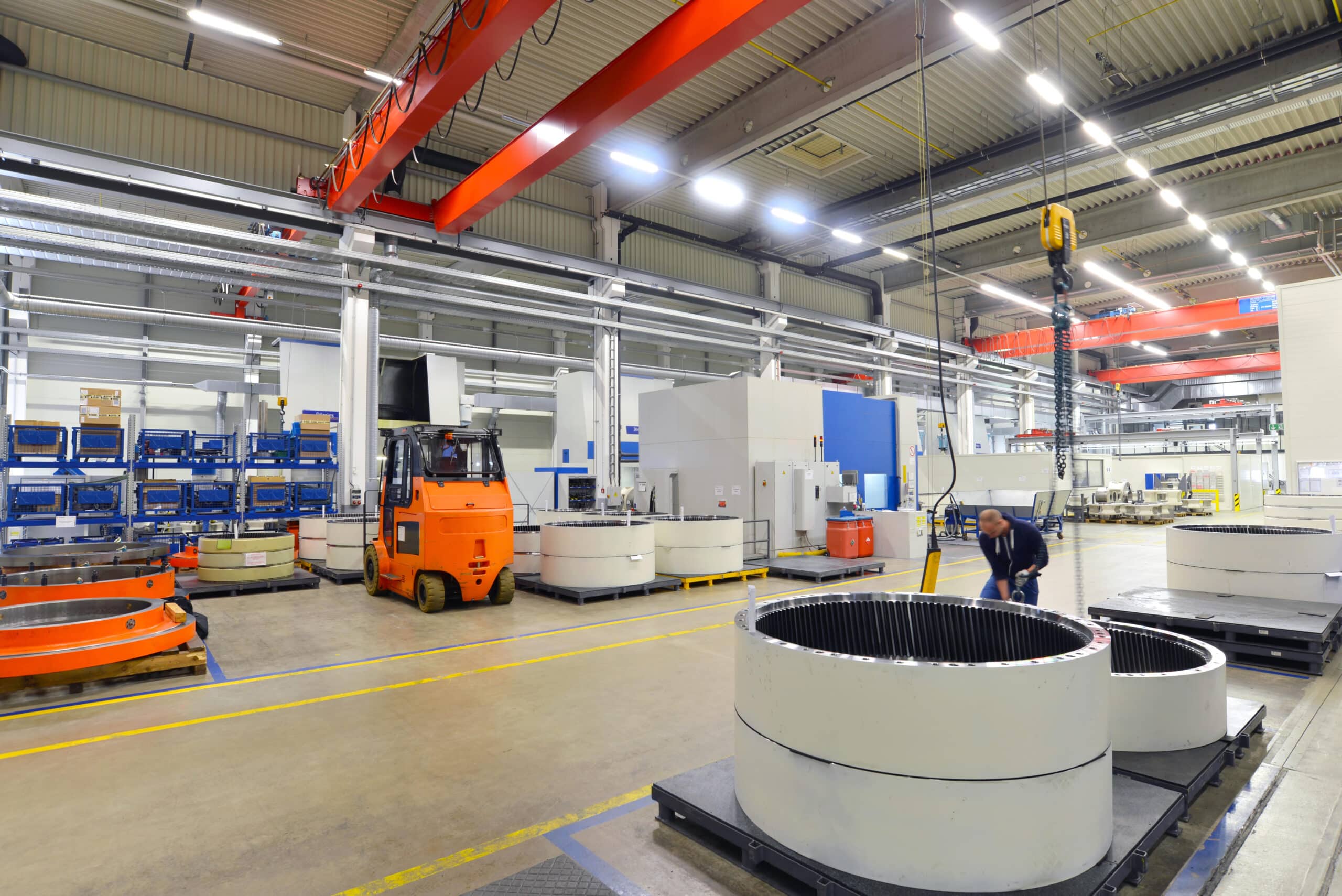
Within the industrial/commercial sectors there are too many industries and commercial activities with which we have dealt to list, but the ones which come up most frequently are garages and car body repair shops, blacksmiths and other metal working shops, sawmills, manufacturing joinery, construction, waste water treatment, waste transfer stations, supermarkets, car washes, kennels, and, rather curiously, nurseries. Within industry, it is often the noise of heavy goods vehicles manoeuvring, and being unloaded and loaded by fork-lift trucks, which is most problematic, and so we have a great deal of experience of this type of noise. Many of these planning applications are carried out to British Standard 4142:2014+A1:2019 Methods for rating and assessing industrial and commercial sound.
“Leisure” is mostly work with the licensed trade. We are always dealing with applications to construct or modify night-clubs, pubs, restaurants and take-aways. This mostly involves controlling the emission of music, but can also involve the noise of cars, smoking shelters, beer gardens, extract fans, and activity in kitchens. Also common in this category is the noise of multi use games areas (MUGAs), skate parks, pump tracks, gyms and fitness studios.
We are blessed with repeat business from many blue chip companies, as you will see on our Satisfied Clients page.
Most are carried out in Edinburgh, Glasgow, the central belt, Aberdeen and Dundee, but we have been as far afield as Scalloway on Mainland Shetland in the north, Lockerbie in the south, Rothesay on the Isle of Bute in the south-west, and Fort William in the north-west. In 1997, Charlie worked on an automated processing centre for Royal Mail in Northern Ireland, and indeed we will be delighted to quote for jobs anywhere in the UK and Ireland.
Most instructions to carry out noise surveys/assessments for industrial and commercial planning applications are taken from the developers themselves, the project manager, architect or planning consultant working on the job.
We are delighted to be asked regularly to carry out noise impact assessments for many local authorities and:
Some local authorities in Scotland have their own guidance on noise. Some stipulate that it be considered as prescribed in The Scottish Government publications Planning Advice Note PAN 1/2011 Planning and Noise and Technical Advice Note TAN 2011 Assessment of Noise. In turn, the latter document suggests the use of British Standard 4142:2014+A1:2019 Methods for rating and assessing industrial and commercial sound. Generally the principle is to predict what level of noise the new development will generate at and/or inside the nearest houses. We do this based on measuring the noise of a similar operation, or using sound level data measured elsewhere in the past, as described below.
The most obvious way of dealing with industrial and commercial noise is to assess it to British Standard 4142:2014+A1:2019 Methods for rating and assessing industrial and commercial sound (BS 4142). Most local authority planning officers stipulate that industrial noise be considered in this way. This involves predicting what the level of industrial noise will be at the houses or flats once the project is up and running, and comparing it to the existing background noise.
Prediction of the industrial noise is often done using our extensive database of levels measured in the past on previous projects. This avoids having to visit similar premises to measure the noise and so keeps the cost of the exercise down. Similarly, sometimes manufacturer’s data can be used to predict the noise, for example, earth moving plant comes with good information on noise levels. If, however, we do not have any information on file, because the industrial process is unusual to us, we will visit the site of a similar factory, process, or plant, and measure the noise. The results of the noise level measurements can then be used to calculate what levels will emanate from the new development and propagate to the nearest houses or flats.
Measurement of the background noise is generally straightforward. It is measured at the house/flat which will be most affected by the industrial noise. As the background noise varies with time, it has to be measured over a period of several hours. It is, of course, measured at a time when the business is going to be operating. For a business which is going to operate during the day, the reference time interval, as it is called in BS 4142, is one hour. As the background noise varies, it is usually measured over 2 or 3 hours to encompass the changes in level. At night, the reference time interval is 15 minutes, and so the background noise is measured over 8 or 12 consecutive 15 minute periods, depending on when the factory or business is going to be operating.
Unfortunately, for the developers, the assessment to BS 4142 often concludes that the noise will lead to complaints. As well as recommending how to control the noise, what we also do, to help present the planning application in the best possible light for the developer, is calculate the noise levels inside the houses. These can then be compared to the limits at which sleep and daytime living disturbance are taken to occur. This is not as punitive as using BS 4142, and so can be used to support a development where the assessment to BS 4142 does not.
We have measured the noise in dozens of restaurants, pubs and night-clubs and kept the results in a large database. These noise levels can be put, on paper, into your proposed restaurant, pub, or night-club. Then, using details of the construction of the building, we can calculate how much noise will get out of the building and propagate to the residential properties affected. From the noise level at the façade of the residential properties, we can calculate how much will get into them. The internal noise level is then compared to the criterion known as inaudibility which all local authorities in Scotland apply. If the noise proves to be excessive we recommend how to modify the structure of the licensed premises to contain the noise. We can also recommend how to control the noise by modifying the sound system in the premises.
We have also measured the noise emanating from many multi use games areas (MUGAs) skate parks and gyms and kept the results in a database. These noise levels can be put, on paper, onto your proposed sports’ facility or into your proposed gym. Then, using details of the layout or construction of the building, we can calculate how much noise will propagate from the facility, or out of the gym, to the residential properties affected. From the noise level at the façade of the residential properties, we can calculate how much will get into them. The internal noise level is then compared to the limit applied by the local authority. If the noise proves to be excessive we recommend how to modify the layout of the sports’ facility or the construction of the gym to contain the noise.
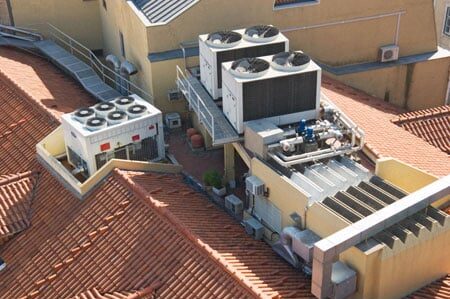
It is usual to obtain the noise data from the manufacturer of the plant and use this to calculate how much will propagate to the nearest flats or houses. From the noise level at the façade of the residential properties, we can calculate how much will get into them. Virtually all local authorities in Scotland apply a limit of noise rating (NR) 35 to this type of noise during the day, and NR25 to it at night. If the noise proves to be excessive, we recommend how to control it by provision of silencers, acoustic louvres, acoustic enclosures, barriers and other means.
This, being temporary, is not usually of concern to the planning officer. When it is, the officer may ask for an assessment of the noise to British Standard 5228-1:2009+A1:2014 Code of practice for noise and vibration control on construction and open sites – Noise. This is a large document which is pretty daunting to the uninitiated. We can use it to predict the noise levels that the construction work will cause and advise on how to comply with the limits given in the Standard.
When a new road is planned, or an existing one modified, the planning officer may ask that the noise of the traffic be predicted at existing houses/flats in the vicinity. We can do this using the procedures set out in Calculation of Road Traffic Noise published by the Department of Transport. The noise levels are then compared the limits, given in The Noise Insulation (Amendment) Regulations 1988, at which grants must be given to insulate the houses/flats. Sometimes the noise is compared to the 35dB(A) and 30dB(A) day and night-time limits suggested in Planning Advice Note PAN 1/2011 Planning and Noise with respect to transportation noise. If the noise looks likely to be excessive we can recommend ways to reduce it.
Even less common than new roads are new railways. We have, however, been asked to consider noise from the new railway from Stirling to Kincardine, and the proposed south suburban line in Edinburgh. This has been done using Calculation of Railway Noise, by the Department of Transport, and our extensive database of noise levels measured beside existing railways. We were also asked to work out whether noise from the tram system in Edinburgh and a light rail link from the airport to the city centre would bother residents along their routes.
A single assessment position is usually sufficient, at the most exposed house or flat. The principle in this is that, if the noise is acceptable at the most exposed house or flat, it follows that it will also be acceptable at the other, less exposed ones. In any event, the planning officer will not accept the results of assessments made on houses or flats which are not the most exposed to the noise.
We know, from what we have seen and heard, that our service is better than that offered by many of our competitors. The many reasons for this follow.
We can normally carry out noise surveys at one or two day’s notice, to fit in with your planning application programme. (We fully appreciate the pressure you are under to get information to planning officers by a certain date and the cost implications if you miss it). If we say we will get the information to you by a certain date, we will.
Even if work has started on site, we do not insist that it stops while the noise is measured, we can usually work around it somehow.
We can compete on price and give 15% and 20% discounts for retained commissions.
We use only Brüel & Kjær instruments. These are the “Rolls Royce” of acoustical instrumentation and give more accurate results than that used by some of our competitors. This is important as inaccurate readings can lead to you having to incorporate expensive noise control measures in the new industrial or commercial premises, which may not, in fact, be necessary.
Noise measurements are made by Peter Dunlop or Sandy Lamb. Other companies may leave their instruments supervised by a technician or person with no knowledge of acoustics. (Both Peter and Sandy have honours degrees in audio and music technology, many years’ experience in environmental noise, and are members of the Institute of Acoustics). The risk in this approach is that the person may not notice if the measurements are corrupted by extraneous noise, such as that from road works, construction work, aircraft, livestock, pedestrians, birds, etc. What, on the face of it, are slight differences in the intervening ground between the factory and the measurement position, can also significantly affect the measured sound levels. Only the experienced acoustician can assess these in-situ and ensure that the measurement position will not prejudice the progress of the planning application. Both these factors, of extraneous noise and reflections, would lead to artificially high levels being reported. In turn, this might mean that you have to incorporate noise control measures in new industrial or commercial premises which are not in fact necessary. Otherwise, it might mean that your application fails, or that you have to include expensive noise control measures that are not actually necessary.
Analysis of the results, calculations and preparation of the report are carried out by Peter, and checked by Sandy, or vice-versa. Sometimes they will ask Charlie to check calculations and reports.
From start to finish your noise impact assessment is dealt with by experienced, highly qualified acousticians.
Other companies’ methods can lead to expensive noise control measures being put in place which are not necessary. The reasons for this follow.
When measuring an existing noise source, some companies leave their instruments supervised by a technician or person with no knowledge of acoustics. The risk in this approach is that the person may not notice if the measurements are corrupted by extraneous noise, for example, if dealing with factory noise, that from road traffic, aircraft, trains, birds, pedestrians, wind in trees and other vegetation, etc. What, on the face of it, are slight differences in the intervening ground between the noise source and the measurement position, can also significantly affect the measured noise levels. Only the experienced acoustician can assess these in-situ and ensure that the measurement position used is not prejudicing your case. Both these factors, of extraneous noise and reflections, would lead to artificially high levels being reported. In turn, this might mean that you have to incorporate expensive noise control measures in the design of the new factory which are not in fact necessary.
Similarly, when measuring an existing noise, some companies leave an instrument unattended for 24 hours. The problem with this is that you do not know what has made the noise, for example traffic, aircraft, and the noise of gulls and crows early in the morning can be considerably greater than anything else. This extraneous noise might wrongly be attributed to that from the factory, plant, etc, which again might mean you have to incorporate expensive noise control measures in the design of the new factory which are not in fact necessary.
Calculations performed by some other consultants, whose work we have seen, use quick and relatively simple equations, which err on the side of caution. In this, they tend to over-estimate the noise levels likely at the houses or flats. Again this might mean that you have to include expensive noise control measures in your development which are not necessary. Charlie Fleming Associates uses very complex equations which work out the noise levels more accurately, and hence any noise control measures will be more precisely specified than they would perhaps be by some other consultants.
In one year alone, we were commissioned 6 times to carry out work which had been done badly by other “acousticians”. In these cases the first fee, paid to the other firm, was a waste of money and accepting the cheaper quotation proved to be a false economy. More importantly, in one case, had the noise control measures suggested by another firm been implemented, over £200,000 would have been spent. Our more detailed measurements showed that the control measures were not necessary. In another, the glazing specification, prepared by the other consultant for a large housing development in Aberdeen, was reduced once we had measured the noise and calculated the internal levels more carefully. This saved the client hundreds of thousands of pounds. In another case, our more precise calculations meant that the developer was able to double the number of houses he could construct on the land. In the remaining cases, the reports by the other firms were rejected by the planning officers, and the developments did not proceed until we had dealt with them.
This continues, every year with around three or four jobs coming to us because other “acousticians” have not managed to carry out the work satisfactorily.

Proin ultrices metus idve eget rhoncus eut quis lacinia amet orci lorem ipsum amet.

Proin ultrices metus idve eget rhoncus eut quis lacinia amet orci lorem ipsum amet.

Proin ultrices metus idve eget rhoncus eut quis lacinia amet orci lorem ipsum amet.

Proin ultrices metus idve eget rhoncus eut quis lacinia amet orci lorem ipsum amet.