
Just as one man’s food is another man’s poison, one man’s music is another man’s noise! This might be quite literal, in that your 25,000 Watt PA system is pumping out dance music to your busy night-club, but that music is driving your neighbours mad. The humming of your dust extract cyclone might be music to your ears, a gentle reminder in the background that your factory is in full production, but it might be annoying everyone else in the area.
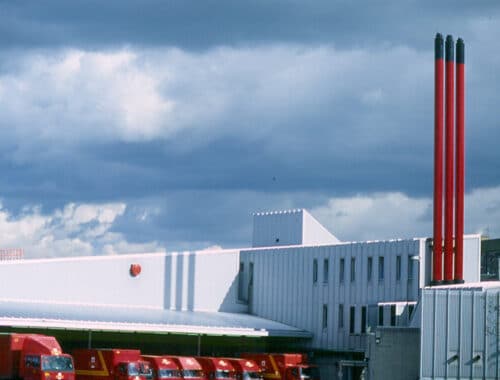
We have worked on complaints about noise from many weird and wonderful sources, from fish farms to laundries, ships to dogs. The sources of noise which occur most frequently are, however, music from pubs and night-clubs, mechanical services plant, construction work, electricity substations, heavy goods vehicles, delivery depots and distribution centres, restaurants, metal and woodworking factories, chemical and food processing plants.

Most noise nuisance complaints come from private individuals, and so are taken up by local authority environmental health officers on their behalf. Most of our work in this field is commissioned by the business, in response to action being taken against it by the environmental health officer. We then advise the business on how to reduce the noise by the amount required by the officer. If appropriate, we will contest the reduction required, or even the entire action.
As mentioned above, most complaints come from private individuals and are taken up by environmental health officers. Environmental health officers do not generally take up complaints of nuisance made by a business. Sometimes, they will refuse to pursue a complaint, either because they do not deem the noise great enough to constitute a nuisance, or for political reasons. In these situations the complaint can be pursued under common law. This involves one party taking legal action to try and stop the other making the noise. The matter is usually resolved by the lawyers, but occasionally will go to proof in the Sheriff Court, or even the Court of Session. These are rare, however, in comparison to ones involving environmental health officers.
We do not often get involved in cases of vibration nuisance, but have consulted on ones involving traffic, buses and construction work.
At any one time, we have one or two noise nuisance cases on our books. Charlie has been working on noise nuisance cases since the start of his career in London in 1983. Charlie Fleming Associates has dealt with over two hundred cases and so there is a wealth of experience in this field.
We usually act for a business defending action being taken by a local authority environmental health officer. The sources of noise which occur most frequently are, music from pubs and night-clubs, mechanical services plant, construction work, electricity substations, vehicles, fork-lift trucks, delivery depots and distribution centres, restaurants, metal and wood working factories, chemical and food processing plants.
Most noise nuisance cases on which Charlie has consulted have been in the central belt, but the fish farm was off the Ardnamurchan peninsula, he worked on a waste water pumping station problem in Brora, and went down to Lockerbie to consider a bus noise problem. Charlie Fleming Associates will be delighted to quote for work anywhere in the UK and Ireland.
Two of the common law cases with which he has been involved went to court, and got as far as the initial submission of evidence. They did, however, then settle, without Charlie’s evidence being heard. He has though, in planning inquiries and occupational deafness litigation, been cross-examined and performed well in this hostile environment. On one occasion he dealt very well with cross-examination by the eminent K.C. John Campbell.
Most instructions to consult on noise nuisance come from the business defending action being taken by a local authority environmental health officer. Very occasionally we act for a private individual against another, or against a company.
Charlie Fleming Associates has worked regularly for several blue chip companies and high street names, helping them resolve noise nuisance complaints. For fairly obvious reasons it would not be appropriate to list those companies here.
Some of the legal firms with which we have worked are:
Peter Dunlop usually carries out this work. He will arrange, with the environmental health officer, to visit the house of the complainant and measure the noise therein. He will then calculate by how much it has to be reduced to get it down to the level which will satisfy the environmental health officer. If he thinks that the level is too strict, he will contest this with the officer. Details of how we solve particular noise nuisance cases follow.
If the offending noise is music emanating from a night-club, pub, etc, Peter will firstly cast an experienced eye around the building. This initial appraisal will lead him to conclude as to which sound transmission paths out of the various elements of the building are likely to be significant. The elements of the building which are usually significant are the roof, windows, doors, ventilation outlets and inlets, and sometimes the walls. He will then measure the noise in the building close to these elements. The distance from the complainant’s house to the elements of the building, together with their dimensions, will also be measured. The materials of which the various elements of the building are made will also be noted. The noise levels measured inside, together with this other information, can then be used to calculate the relative significance of the elements of the building. This is essential in providing cost effective advice, as it shows exactly by how much the sound emanating from each element of the building must be reduced, and the noise control measures required can be specified precisely.
Most local authorities stipulate that the noise must be controlled so that it is inaudible. Whilst we do not agree with this criterion, it is well established now and contesting it is not advised. Notwithstanding, what level environmental health officers consider will, or will not, be audible, varies, and there is sometimes scope for discussion on this.
The noise control measures might involve re-designing the sound system, modifying the construction of the building, or erecting an acoustical barrier between it and the complainant’s house. There are also a number of other ways of solving this type of noise nuisance.
If the noise is emanating from a factory building, the approach to the problem is exactly the same as that outlined above under Music Noise. There is, however, no set level to which the noise must be reduced, and we usually work to those published by the World Health Organisation and in British Standard 8233: 2014 Guidance on sound insulation and noise reduction for buildings (BS 8233). Some environmental health officers stipulate that the noise be assessed to British Standard 4142:2014+A1:2019 Methods for rating and assessing industrial and commercial sound (BS 4142). This document is very punitive against the party making the noise, and we have a long list of reasons which we present to the environmental health officer to contest its use.
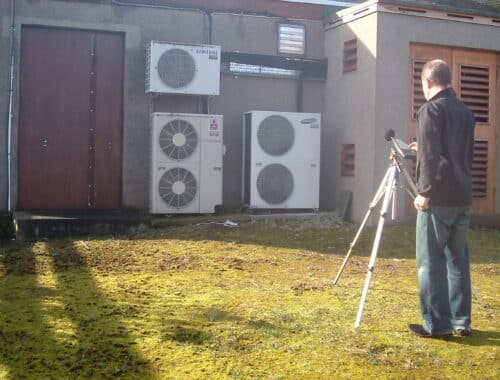
If the source of the complaint is mechanical services plant, the measurement exercise will involve switching various items on and off to establish which one, or ones, are causing the problem. A detailed investigation close to the offending item(s) will then be made to determine how it is radiating the noise. Again, this means that the noise control measures can be specified precisely.
Most environmental health officers impose a noise level limit of noise rating, abbreviated to NR, 25 to this type of noise at night, and NR35 to it during the day. To reduce the noise to these levels might involve, for example, fitting an in-duct attenuator, installing acoustic louvres, lagging ductwork, re-orientation of the duct termination, constructing an acoustic enclosure around the plant, or building an acoustic barrier between it and the receiver.
In these types of installations, the noise may be emanating from a building, in which case it is dealt with as described earlier under Industrial Noise. There may also be many items of plant located outside. These are often dealt with in the much same way as described under Mechanical Services Plant Noise. Whilst the items of plant are mechanical services, environmental health officers sometimes try to have them considered under BS 4142, which for reasons given earlier, we will contest.
If the source of the complaint is heavy goods vehicle movements, fork-lift trucks or other mobile plant, the noise will be measured to establish which one, or ones, are causing the problem. There is no set level to which the noise must be reduced, and we usually work to those published by the World Health Organisation and given in BS 8233. To control the noise, quieter plant can sometimes be brought in, working practices changed, loading bays modified, acoustic enclosures built, bunds or acoustic barriers erected.
The sources of noise in these premises can be a mixture of that emanating from buildings, which are then considered as described earlier under Industrial Noise, and that from mobile plant, which is dealt with as discussed under Heavy Goods Vehicles and Mobile Plant.
This does not cause problems very often, as environmental health officers generally adopt a pragmatic view that it is temporary. Furthermore, applying noise control measures will tend to prolong the construction programme, so the complainant gets lower levels of noise, but for longer. When dealing with this kind of complaint, the noise of the various items of plant, and activities, is measured. The offending items are then identified and the reduction in noise required calculated.
Some local authorities have developed their own limits for this type of noise, and these are usually quite easy to achieve. We can advise on whether these limits will be achievable, as they are sometimes contained in what is called a Notice of Prior Consent, issued by a local authority before work commences. If exceeding the limits, and we consider them to be fair, noise control can then be applied in the form of acoustic enclosures, using quieter items of plant, applying silencers or “hush-kits” to plant, erecting acoustic barriers and so on. We will also consider the methods and procedures suggested in British Standard 5228-1:2009+A1:2014 Code of practice for noise and vibration control on construction and open sites – Noise . This document might well be referred to in correspondence from the environmental health officer.
As with many other sources of noise, there is no set level to which that from sports pitches must be reduced, and we usually work to those published by the World Health Organisation and given in BS 8233. Methods of reducing the noise are limited, but acoustic barriers can be designed and put in place, and the boards and fencing used modified to reduce the noise of the balls hitting them.
If we consider that the environmental health officer’s target is unreasonable, as they sometimes are, we may advise you to contest it. We may also suggest that you use the defence of best practicable means. The essence of this is that you state that you have done everything you can reasonably be expected to do to reduce the noise. It may also be the case that further expenditure on noise control would compromise the continuing success of your business.
We know, from what we have seen and heard, that our service is better than that offered by many of our competitors. The many reasons for this follow.
If you are allegedly causing a nuisance, you could end up in court if you do not reduce the noise within the timescale set down by the local authority officers. We act immediately by contacting the enforcing authority to let it know we have been appointed, which buys some time. Then we can normally measure the noise within a week. If we say we will get the report to you by a certain date, we will.
Our fees are competitive and we give discounts for long term and retained commissions.
If we provide a quotation we will stick to it. That is what you pay, regardless of how long it actually takes us to carry out the work.
Other companies’ methods can lead to expensive noise control measures being put in place which are not necessary. The reasons for this follow.
Some companies may leave their instruments supervised by a technician or person with no knowledge of acoustics. The risk in this approach is that the person may not notice if the measurements are corrupted by extraneous noise, for example, that of traffic, when music is the source of the complaint. Only the experienced acoustician can assess this in-situ and ensure that artificially high levels are not being reported. Artificially high levels might mean that you have to pay for expensive measures to control noise which is not actually emanating from your pub, factory or plant.
Some companies leave an instrument unattended for 24 hours. The problem with this is that you do not know what has made the noise. Again traffic noise may be adding to that from your factory, and you might find yourself paying for noise control measures which are not actually necessary.
Calculations performed by some other consultants, whose work we have seen, use quick and relatively simple equations, which err on the side of caution. In this, they tend to over-estimate the noise levels, which again can mean that you have to include expensive noise control measures which are not necessary. Charlie Fleming Associates uses very complex equations which work out the noise levels more accurately, and hence any noise control measures will be more precisely specified, and cost effectively, than they would perhaps be by other consultants.
In one year alone, we were commissioned 6 times to carry out work which had been done badly by other “acousticians”. In these cases the first fee, paid to the other firm, was a waste of money and accepting the cheaper quotation proved to be a false economy. More importantly, in one case, had the noise control measures suggested by another firm been implemented, over £200,000 would have been spent. Our more detailed measurements showed that the control measures were not necessary. In another, the glazing specification, prepared by the other consultant for a large housing development in Aberdeen, was reduced once we had measured the noise and calculated the internal levels more carefully. This saved the client hundreds of thousands of pounds. In another case, our more precise calculations meant that the developer was able to double the number of houses he could construct on the land. In the remaining cases, the reports by the other firms were rejected by the planning officers, and the developments did not proceed until we had dealt with them.
This continues, every year with around three or four jobs coming to us because other “acousticians” have not managed to carry out the work satisfactorily.

We use a Brüel & Kjær Hand Held Analyzer Type 2250 to measure the noise. Brüel & Kjær is the “Rolls Royce” of acoustical instrumentation, and the 2250 is the most accurate and reliable hand-held sound level meter available on the market. This is important as inaccurate readings can lead to you having to incorporate expensive noise control measures in your factory, pub, etc, which may not, in fact, be necessary.
Having measured the noise and considered the case, we will not hesitate to argue with the environmental health officer if we think that a nuisance does not exist. Conversely, if we think that the complaint against you is justified we will tell you that. We will, however, always listen sympathetically to the complainant, regardless of whether we think they have a justified case or not, to help diffuse or ameliorate the situation.
It is unusual that a noise nuisance action goes to court, but Charlie has been cross-examined in the Court of Session twice and performed well on both occasions. He has also been cross-examined in other courts and several public inquiries, and has dealt with the questions perfectly well.
Some other acousticians present evidence in a manner which they think will assist the client. Charlie believes that this is not the role of the expert witness. Doing this can leave the client exposed should the evidence be tested in court. Indeed, a senior KC once told Charlie that he would not use a certain acoustic consultant because his evidence had never stood up under cross-examination.
Some other acoustic consultants, to whom Charlie has spoken, are quite emphatic in that they are not willing to put themselves under cross-examination.

Proin ultrices metus idve eget rhoncus eut quis lacinia amet orci lorem ipsum amet.

Proin ultrices metus idve eget rhoncus eut quis lacinia amet orci lorem ipsum amet.

Proin ultrices metus idve eget rhoncus eut quis lacinia amet orci lorem ipsum amet.

Proin ultrices metus idve eget rhoncus eut quis lacinia amet orci lorem ipsum amet.